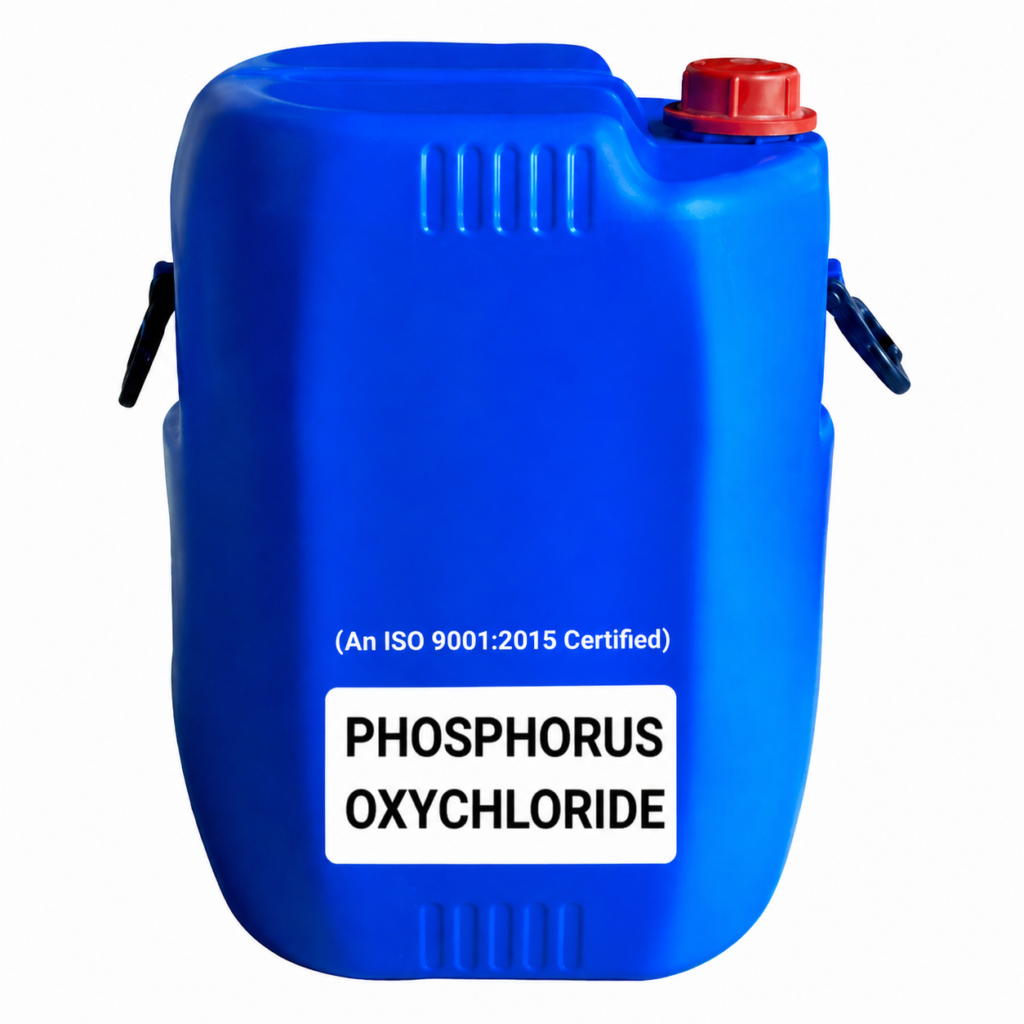
Phosphorus oxychloride (POCl3) is a colorless, fuming, and highly corrosive liquid with a pungent odor, frequently used as a chlorinating and dehydrating agent in chemical synthesis. It is vital in producing pharmaceuticals, flame retardants, and insecticides, and it works as a catalyst (e.g., in Vilsmeier-Haack reactions). Due to its reactivity and toxicity, it requires careful handling.
Structure & Properties possesses a tetrahedral structure with a central phosphorus atom double-bonded to an oxygen atom and single-bonded to three chlorine atoms. It is a dense, volatile liquid (d=1.675 g/cm3) with a boiling point of approximately . is synthesized industrially by the oxidation of phosphorus trichloride (PCl3) with oxygen or by reacting with phosphorus pentoxide (P2O5).